AI News
Anthropic Warns About Self-Improving AI and Coordinated Pause Mechanisms
Anthropic warns that AI systems are taking a larger role in AI development and says frontier labs may need a coordinated, verifiable way to slow or pause development if risks rise.
💡Key Takeaways
- Anthropic warns that AI systems are taking a larger role in AI development and says frontier labs may need a coordinated, verifiable way to slow or pause development if risks rise.
Hot AI News Today: Anthropic Warns About Self-Improving AI
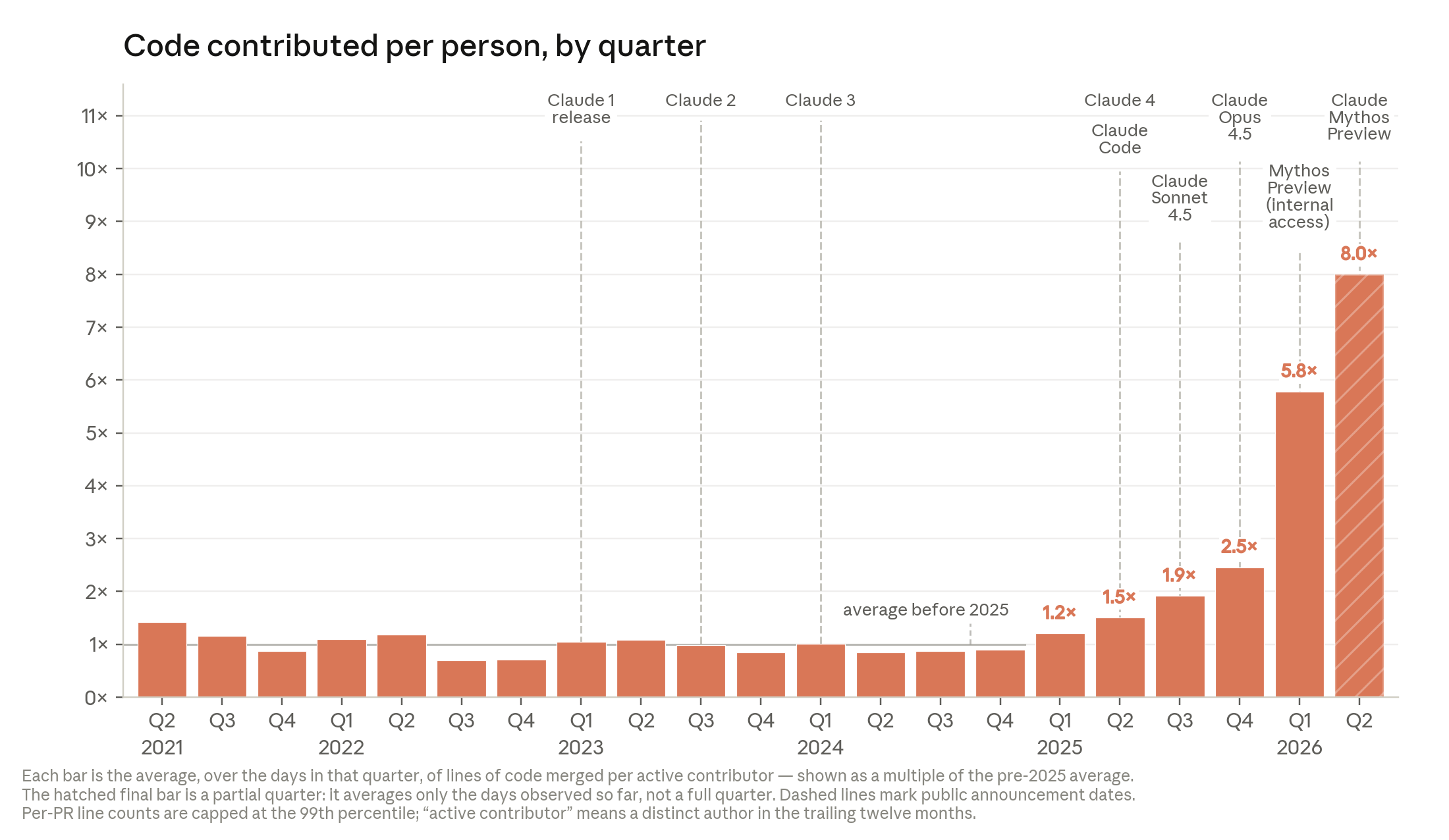
Image: “Code contributed per person, by quarter,” published by Anthropic in “When AI builds itself.” Image source: Anthropic. Image format: PNG, not SVG. Source link: https://www.anthropic.com/institute/recursive-self-improvement
Quick Summary
Anthropic has published a new analysis titled “When AI builds itself,” warning that AI systems are becoming increasingly involved in the process of developing AI itself. Reuters reports that Anthropic wants frontier AI developers to establish a coordinated and verifiable way to slow or temporarily pause development if advanced systems begin improving themselves faster than society can manage the risks.
The most striking figure is Anthropic’s own internal metric: as of May 2026, more than 80% of the code merged into Anthropic’s codebase was authored by Claude. This does not prove that AI is already fully self-developing, but it is a strong signal that AI is moving from a coding assistant role toward a deeper role in software engineering and AI research workflows.
What Happened?
Anthropic says that for most of AI’s history, humans controlled every step of the development cycle: writing code, testing systems, reviewing outputs, fixing bugs, and designing new models. That workflow is changing. Advanced coding agents can now write and edit files, run code, debug issues, and complete longer technical tasks.
According to Anthropic’s official post, if this trend continues and enough compute is available, AI systems may eventually help design or refine their own successors. Anthropic calls this scenario “recursive self-improvement.” The company stresses that this has not happened yet and is not inevitable, but it may arrive sooner than many institutions are prepared for.
Reuters separately reported the core news: Anthropic is calling for major AI labs to prepare a coordinated, verifiable mechanism to slow or pause frontier AI development if risks rise, rather than relying on isolated action by a single company.
Why This Story Matters
This is one of the hottest AI stories today because it connects three major issues: the speed of AI progress, human control, and AI governance.
First, the more-than-80% code figure suggests that AI is no longer limited to short code suggestions. Inside Anthropic’s own engineering workflow, AI is already playing a large enough role to change technical output. Anthropic also says the average engineer in Q2 2026 was merging about 8 times as much code as before 2025, while cautioning that lines of code are an imperfect measure of true productivity or quality.
Second, Anthropic is not only talking about productivity. It is raising a control problem. If AI systems can help build better AI systems, the improvement cycle may speed up faster than humans can evaluate, validate, secure, and govern.
Third, Anthropic is not calling for an immediate shutdown of AI development. The key proposal is to prepare a coordination mechanism: when a slowdown should happen, who verifies it, what conditions trigger it, which labs participate, and how to avoid a scenario where cautious actors pause while less cautious actors keep accelerating.
What “Recursive Self-Improvement” Means
Recursive self-improvement does not mean that a chatbot suddenly becomes a fully independent system overnight. In this context, it means AI systems gradually taking on more of the work involved in building AI: writing code, debugging systems, running tests, automating research, optimizing infrastructure, and helping design future model versions.
The risk is not a single isolated action. The risk is the speed of the loop. If AI helps make better AI, and the better AI then helps create an even stronger successor, the development cycle could accelerate rapidly. Safety testing, security review, model behavior evaluation, legal accountability, and human oversight could struggle to keep up.
What Has Been Verified
Anthropic’s official source confirms that the company is delegating a growing share of AI development to AI systems; that Claude authored more than 80% of the code merged into Anthropic’s codebase as of May 2026; and that Anthropic believes recursive self-improvement may arrive sooner than many institutions expect.
Reuters confirms that Anthropic is calling for a coordinated, verifiable way for frontier AI developers to slow or temporarily pause development if risks rise. Reuters also reports Anthropic’s warning that a unilateral pause by one company could have limited impact or even backfire if less cautious competitors continue accelerating.
Important caveat: the internal code contribution metric is Anthropic’s own reported data. Reuters reported and contextualized the statement, but that does not mean Reuters independently audited Anthropic’s internal measurement pipeline.
Impact for Developers and Businesses
For developers, the story shows that coding agents are advancing quickly. AI is not only generating boilerplate; it is increasingly able to work through longer, more complex, multi-step engineering tasks. However, human review is not disappearing. Anthropic itself says human review has become a new bottleneck as more code is pushed through the organization.
For businesses, the practical lesson is that AI coding tools should not be evaluated only by speed. The more important question is accountability: who is responsible if AI-generated code introduces bugs, security flaws, data leakage, copyright risk, or unpredictable system behavior?
For policymakers, the story strengthens the case for clearer evaluation standards and oversight mechanisms for frontier AI. If leading labs increasingly automate model development, voluntary reporting alone may not be enough.
Balanced View
Anthropic’s argument is intentionally cautionary, but it should not be read as proof that AI has already escaped human control. Anthropic itself says recursive self-improvement has not happened and is not guaranteed.
Still, this is a major story because it comes from one of the most important frontier AI companies and is based partly on internal evidence about how AI is changing software development. When a leading AI lab says the industry should prepare the option to slow or pause under certain conditions, the technology sector should take the signal seriously.
FAQ
Is Anthropic asking AI labs to stop development immediately?
No. The proposal is to prepare a coordinated and verifiable slowdown or pause mechanism that could be used if risks rise.
Does “more than 80% of code was authored by Claude” mean engineers are no longer needed?
No. Anthropic describes engineers as still directing, reviewing, and taking responsibility for the work. The figure shows a major shift in software development workflows, not the removal of humans from the process.
Why should ordinary users care?
Users may soon see more powerful AI agents for coding, automation, research, and office work. At the same time, questions about safety, responsibility, and control will become more important.
Verification Sources
- Anthropic — “When AI builds itself”: https://www.anthropic.com/institute/recursive-self-improvement
- Reuters — “Anthropic says AI labs need coordinated plan to halt development if risks rise”: https://www.reuters.com/business/anthropic-says-ai-labs-need-coordinated-plan-halt-development-if-risks-rise-2026-06-04/
- Image source: Anthropic chart from “When AI builds itself”: https://www-cdn.anthropic.com/images/4zrzovbb/website/52a19d636c659cf4515dc0d7d70b8ceb1bbfd768-2200x1276.png
Written by PixelRouter Editorial Team
We publish deep, authoritative guides on AI infrastructure, API gateway security, cloud financial management, and system optimizations for developers.
FAQ
Is Anthropic asking AI labs to stop development immediately?
No. The article says Anthropic is calling for a coordinated and verifiable slowdown or pause mechanism that could be used if risks rise, not an immediate shutdown of AI development.
Does the claim that more than 80% of code was authored by Claude mean engineers are no longer needed?
No. The article explains that Anthropic still describes engineers as directing, reviewing, and taking responsibility for the work. The figure signals a major workflow shift, not the removal of humans.
What does recursive self-improvement mean in this context?
In this article, recursive self-improvement means AI systems gradually taking on more of the work involved in building AI, such as writing code, debugging, running tests, automating research, optimizing infrastructure, and helping design future model versions.
Why does this matter for developers and businesses?
The article says coding agents are advancing quickly, but human review and accountability remain important. Businesses should evaluate AI coding tools not only by speed, but also by responsibility for bugs, security flaws, data leakage, copyright risk, and unpredictable behavior.
📂Related posts
AI News
Anthropic expands Project Glasswing as Claude Mythos Preview targets critical cybersecurity
Anthropic is expanding Project Glasswing, giving more selected organizations controlled access to Claude Mythos Preview for vulnerability discovery in critical software and infrastructure sectors.
AI News
OpenAI Upgrades GPT-Rosalind for Life Sciences Research
OpenAI has updated GPT-Rosalind, its specialized life sciences AI model, with stronger scientific reasoning, tool use, and support for drug discovery, genomics, and research workflows.
AI News
Microsoft launches seven MAI models to expand its in-house AI stack
Microsoft announced seven in-house MAI models at Build 2026, covering reasoning, coding, image generation, image editing, transcription and voice generation.