AI News
Microsoft launches seven MAI models to expand its in-house AI stack
Microsoft announced seven in-house MAI models at Build 2026, covering reasoning, coding, image generation, image editing, transcription and voice generation.
💡Key Takeaways
- Microsoft announced seven in-house MAI models at Build 2026, covering reasoning, coding, image generation, image editing, transcription and voice generation.
Microsoft launches seven MAI models in a bigger push to build its own AI stack
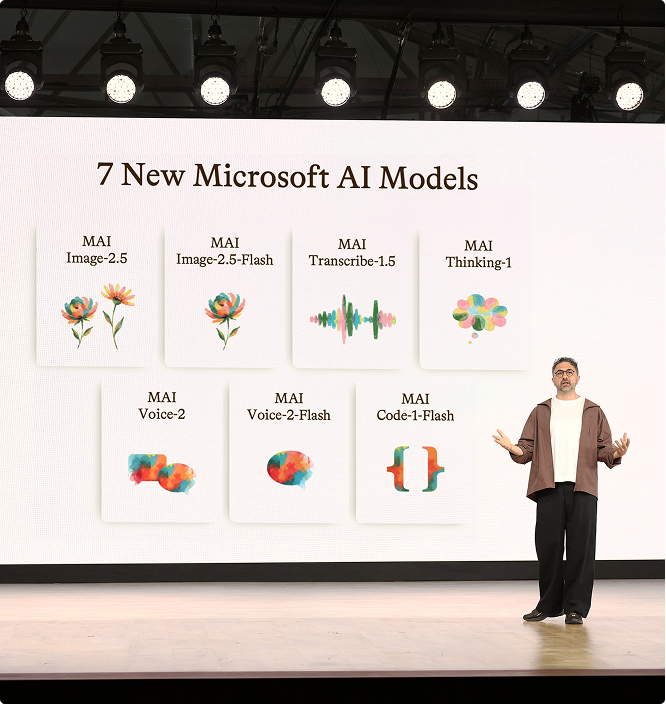
Image source: Microsoft AI, JPG image from “Building a hill-climbing machine: Launching seven new MAI models.” No SVG image is used.
Updated: June 5, 2026
Primary verification sources: Microsoft AI, Microsoft Build Live and The Verge.
Quick summary
Microsoft has announced a new in-house AI model family called MAI, with seven models covering reasoning, coding, image generation, image editing, transcription and voice generation. The headline model is MAI-Thinking-1, Microsoft AI’s first reasoning model, which the company describes as a mid-sized model designed for low token cost, multi-step reasoning, long-context tasks and code generation.
The news matters because Microsoft is no longer only an AI infrastructure provider or a company integrating partner models into Copilot. With the MAI model family, Microsoft is moving deeper into the foundation-model layer itself. That could put the company in more direct competition with model providers such as OpenAI, Anthropic, Google and Meta.
What happened
At Microsoft Build 2026, Microsoft AI announced seven new models developed in-house. According to Microsoft’s official announcement, the models form the MAI model family, a multimodal ecosystem built for real-world tasks across image, voice, transcription, coding and reasoning.
The main model is MAI-Thinking-1. Microsoft describes it as a flagship reasoning model built for complex multi-step instructions, long-context reasoning, mathematical reasoning and code generation. Microsoft also says it trained the model from the ground up on clean data, without distillation from third-party frontier models.
The rest of the lineup includes MAI-Code-1-Flash for coding, MAI-Image-2.5 for image generation and editing, MAI-Transcribe-1.5 for speech-to-text, and MAI-Voice-2 for voice generation. Microsoft Build Live says the image, transcription and voice models are generally available on Microsoft Foundry and MAI Playground, while MAI-Thinking-1 is open first to selected early partners.
The seven MAI models
| Model | Main use | Plain-English meaning |
|---|---|---|
| MAI-Thinking-1 | Reasoning, coding, multi-step tasks | A model for harder work that requires planning, logic and deeper reasoning |
| MAI-Code-1-Flash | Coding and agentic software development | A model built for GitHub Copilot, VS Code and Microsoft’s developer stack |
| MAI-Image-2.5 | Text-to-image and image editing | A model for design, creative production and image workflows |
| MAI-Image-2.5-Flash | Faster and cheaper image workflows | A lighter option when speed and cost matter more |
| MAI-Transcribe-1.5 | Speech-to-text | Useful for meetings, podcasts, videos, notes and call-center workflows |
| MAI-Voice-2 | Natural voice generation | Useful for assistants, narration, accessibility and voice interfaces |
| MAI-Voice-2-Flash | Lower-cost voice generation, coming later | A faster option for large-scale voice use cases |
Why this is important
The first important point is control. Microsoft has long been associated with AI through Azure, Copilot and its partnership with OpenAI. This announcement shows that Microsoft wants stronger control over the model layer itself, not just the apps and cloud infrastructure around it.
The second point is developer distribution. MAI-Code-1-Flash is integrated with GitHub Copilot and Visual Studio Code, while other MAI models are being distributed through Microsoft Foundry, MAI Playground, OpenRouter, Fireworks and Baseten. That means Microsoft wants these models to be used not only inside Microsoft products but also by developers building their own AI applications.
The third point is cost. Microsoft repeatedly emphasizes lower token cost and efficiency. For companies deploying AI agents, code assistants, document processing or voice tools at scale, model cost can quickly become a major operational issue.
What problem is Microsoft trying to solve?
Most organizations adopting AI face three practical questions: Is the model good enough, is the data safe, and can the cost be controlled? The MAI model family is Microsoft’s attempt to answer all three with a more integrated model-and-platform strategy.
On capability, Microsoft is covering reasoning, coding, images, voice and transcription. On data, the company emphasizes clean and enterprise-grade data lineage. On cost, Microsoft is positioning the models as efficient options that can run inside a broader developer and enterprise platform.
Impact for users and developers
For everyday users, the impact may show up indirectly inside Copilot, Office, Windows or other Microsoft products. Better image generation, transcription, voice output, code assistance and complex task handling may become part of the user experience as Microsoft integrates more of its own models.
For developers, the news is more immediate. If MAI models become broadly available on Microsoft Foundry, OpenRouter, Fireworks and Baseten, developers will have another major provider to consider alongside OpenAI, Anthropic, Google Gemini and Meta Llama. MAI-Code-1-Flash also shows that Microsoft wants its coding tools to become a direct distribution channel for its own models.
For enterprises, the bigger message is that AI is becoming a governed work system, not just a chatbot. Microsoft’s Frontier Tuning approach suggests a future where companies can adapt models to their own workflows, policies and internal data instead of relying only on general-purpose models.
Competitive context
The AI model market is shifting from a race over chatbots to a race over model ecosystems, developer tools, cloud infrastructure and enterprise distribution. OpenAI has ChatGPT and its API. Anthropic has Claude. Google has Gemini and Vertex AI. Meta has Llama and developer-focused open models. Microsoft now wants to compete at more layers of the stack: models, developer tools, enterprise software and cloud infrastructure.
The Verge described MAI-Thinking-1 as an ambitious step into model development for Microsoft, noting that the company had previously relied heavily on OpenAI’s models before expanding its own model work. In simple terms, Microsoft may continue to partner with OpenAI, but it is also building its own path.
What to watch next
The first thing to watch is real-world performance. Provider benchmarks are useful, but developers and enterprises will still need independent testing, production latency data and practical cost comparisons.
The second thing is pricing. Microsoft talks about lower cost, but the real cost will depend on API pricing, platform fees, rate limits, latency and how the models behave in large production workloads.
The third thing is access. Microsoft says the models will be available through Microsoft Foundry, MAI Playground, OpenRouter, Fireworks and Baseten, and that developers will be able to tune model weights in some contexts. The exact access terms, tuning options and rollout schedule will matter.
Bottom line
Microsoft’s seven-model MAI launch is a significant AI provider and model-platform story. It shows that Microsoft wants more independence at the model layer while using its existing strengths in GitHub, VS Code, Foundry, Azure and enterprise software to distribute those models.
This is not just another model release. It is a signal that Microsoft wants to be a full-stack AI company: model builder, developer platform, cloud provider and enterprise AI vendor at the same time.
Sources and verification
- Microsoft AI — “Building a hill-climbing machine: Launching seven new MAI models”: https://microsoft.ai/news/building-a-hillclimbing-machine-launching-seven-new-mai-models/
- Microsoft Build Live 2026 — “The next-gen in-house Microsoft AI models”: https://news.microsoft.com/build-2026-live-blog/microsoft-build-2026-live/
- The Verge — “Microsoft’s first advanced reasoning AI is here”: https://www.theverge.com/tech/941664/microsoft-ai-model-reasoning-mai-thinking-1-build-2026
- JPG illustration source from Microsoft AI: https://microsoft.ai/wp-content/uploads/2026/05/Group-2147234751-2.jpg
Written by PixelRouter Editorial Team
We publish deep, authoritative guides on AI infrastructure, API gateway security, cloud financial management, and system optimizations for developers.
FAQ
What did Microsoft announce at Build 2026?
Microsoft announced seven in-house MAI models covering reasoning, coding, image generation and editing, transcription, and voice generation.
What is MAI-Thinking-1?
MAI-Thinking-1 is described in the article as Microsoft AI’s flagship reasoning model for complex multi-step instructions, long-context reasoning, mathematical reasoning, and code generation.
Which MAI models are mentioned in the lineup?
The article lists MAI-Thinking-1, MAI-Code-1-Flash, MAI-Image-2.5, MAI-Image-2.5-Flash, MAI-Transcribe-1.5, MAI-Voice-2, and MAI-Voice-2-Flash.
Where are some MAI models expected to be available?
The article says Microsoft Build Live mentions availability through Microsoft Foundry and MAI Playground for image, transcription, and voice models, with broader developer distribution also discussed through platforms such as OpenRouter, Fireworks, and Baseten.
Why is the MAI launch important for developers?
The article explains that Microsoft is moving deeper into the foundation-model layer and wants MAI models to be used not only inside Microsoft products but also by developers building AI applications.
📂Related posts
AI News
Anthropic expands Project Glasswing as Claude Mythos Preview targets critical cybersecurity
Anthropic is expanding Project Glasswing, giving more selected organizations controlled access to Claude Mythos Preview for vulnerability discovery in critical software and infrastructure sectors.
AI News
OpenAI Upgrades GPT-Rosalind for Life Sciences Research
OpenAI has updated GPT-Rosalind, its specialized life sciences AI model, with stronger scientific reasoning, tool use, and support for drug discovery, genomics, and research workflows.
AI News
South Korea Opens Debate on Sharing AI Chip Profits With Workers and Suppliers
South Korea’s labour minister has urged major technology companies to discuss sharing AI-driven excess profits with suppliers, subcontractors and workers, raising a new policy debate around the AI chip boom.