AI Guides
What Is Shannon? A Beginner-Friendly Guide to the Kocoro-lab/Shannon Repository
Shannon is a production‑oriented framework for building and running AI agents. This guide explains its architecture, token‑budget control, time‑travel debugging, human‑in‑the‑loop approval, and OpenAI‑compatible API, helping beginners compare it with tools like LangChain or CrewAI.
💡Key Takeaways
- Shannon is a production‑oriented framework for building and running AI agents.
- This guide explains its architecture, token‑budget control, time‑travel debugging, human‑in‑the‑loop approval, and OpenAI‑compatible API, helping beginners compare it with tools like LangChain or CrewAI.
Repository: https://github.com/Kocoro-lab/Shannon
Topic: AI agents, multi-agent orchestration, AI workflows, production AI agents
Audience: people learning about AI agents, developers comparing Shannon with LangChain/CrewAI/AutoGPT, and readers who want to understand the repository
Level: beginner-friendly, with minimal jargon
Checked against README, ROADMAP, LICENSE, and CONTRIBUTING: June 13, 2026
Image format: image loaded directly from the repository, no base64 embedding
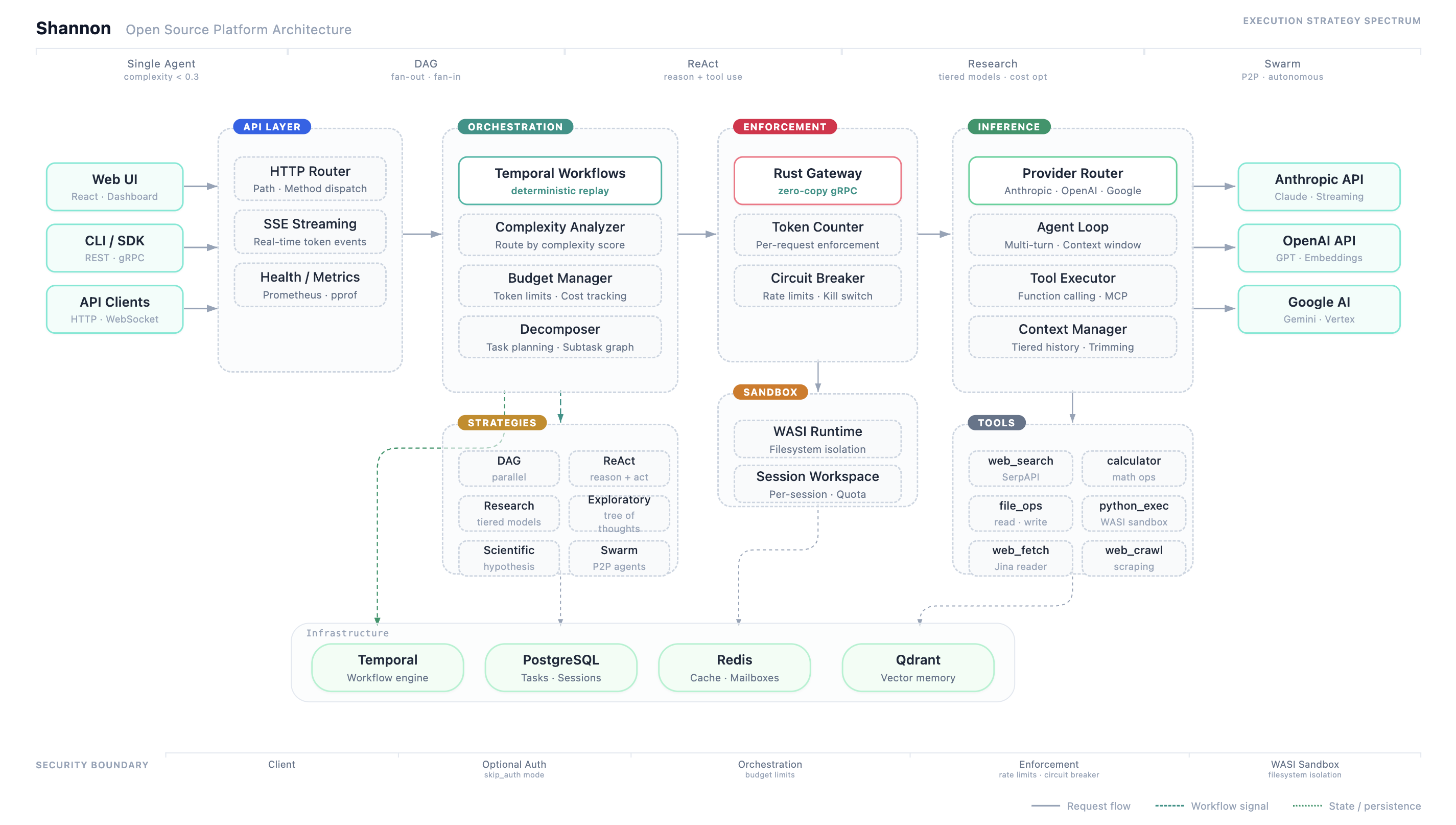
Image source: docs/images/architecture-oss.png in the Kocoro-lab/Shannon repository.
Direct image URL: https://raw.githubusercontent.com/Kocoro-lab/Shannon/main/docs/images/architecture-oss.png
1. What is Shannon?
Shannon is a framework for building and running AI agents in a production-oriented way.
Simple explanation:
Shannon = a system for running multi-step AI assistants with more control, reliability, and visibility.
A normal chatbot usually answers one question. An AI agent can do more:
receive a task
split it into steps
call AI models
use tools
check results
save state
stream progress
ask for human approval when needed
return the final result
Shannon focuses on the difficult parts of using AI agents in real products: preventing silent failures, controlling costs, tracking what happened, replaying failures, and limiting risky actions.
2. Why is this repository interesting?
The README describes Shannon as a production-oriented multi-agent orchestration framework. This means it is not only for agent demos; it aims to support more serious agent deployment.
The README highlights features such as:
Example
In simpler words:
Example
3. What problem does Shannon try to solve?
AI agents sound useful, but real agent systems are difficult to operate.
Agents can fail without clear reasons
An agent may stop midway, call the wrong tool, choose the wrong model, or return a bad answer. If the system does not record each step, debugging is difficult.
Shannon uses workflow replay so you can inspect what happened.
Costs can grow quickly
Agents often call models many times. Without limits, one task may use far more tokens than expected.
Shannon includes token budget control, so each task or agent can have a hard token limit.
Lack of visibility
If you do not know what step the agent is running, which model it used, which tool it called, or how long it took, production operation is hard.
Shannon includes real-time event streaming, Prometheus metrics, and OpenTelemetry tracing.
Security risk
Agents may run code or call tools. Without controls, that can be risky.
Shannon uses WASI sandboxing, OPA policies, and multi-tenant isolation to increase control.
4. What kinds of applications fit Shannon?
Shannon is useful when you need AI workflows with many steps, multiple agents, or production-level control.
Examples:
Example
If you only need one model call for a short answer, Shannon may be too heavy. If you need complex agent workflows, it is worth studying.
5. Shannon architecture in simple terms
The README describes the main architecture as:
Client → Gateway (Go) → Orchestrator (Go) → Agent Core (Rust) → LLM Service (Python) → Providers
Simple explanation:
Client = user app or interface sending requests.
Gateway = API entry point, auth, and rate limiting.
Orchestrator = workflow manager deciding how tasks run.
Agent Core = secure execution layer for token control and sandboxing.
LLM Service = calls AI models and tools.
Providers = OpenAI, Anthropic, Google, DeepSeek, xAI, Ollama, and others.
The repository uses several languages:
Go: gateway and orchestration.
Rust: agent core, sandbox, and enforcement.
Python: LLM service, tools, and agent loop.
Tauri + Next.js: desktop app.
This shows that Shannon is not a tiny library. It is closer to a full backend system for AI agents.
6. Main services in Shannon
Gateway
The Gateway is the entry point.
It handles:
Example
If your app sends tasks to Shannon, the request usually goes through the Gateway.
Orchestrator
The Orchestrator manages workflow execution.
It decides:
Example
You can think of it as the task manager of the system.
Agent Core
Agent Core is the safer execution layer.
It handles:
Example
If an agent needs to run code or use a tool, this layer helps control risk.
LLM Service
The LLM Service talks to AI models.
It handles:
Example
In short, this is the layer that connects Shannon to the AI “brain.”
Desktop App
The repository includes a desktop app built with Tauri and Next.js. The README says it can show real-time agent execution and event streams.
7. How does Shannon run tasks?
Shannon supports multiple execution strategies.
Simple
For simple tasks.
Example:
Example
No complex workflow is needed.
DAG
For multi-step tasks with dependencies.
Example:
Example
DAG helps track what must run first and what can run later.
ReAct
For agents that reason and use tools repeatedly.
Example:
Example
Research
For multi-step research. The README says this strategy can use tiered models for cost optimization, with 50-70% reduction in some scenarios.
Exploratory
For exploring multiple hypotheses in parallel, similar to Tree-of-Thoughts.
Browser Use
For web interaction tasks using a Playwright-backed browsing agent.
Domain Analysis
For specialized analysis in a specific domain.
Swarm
For multiple agents working as a team, with lead orchestration and convergence detection.
Simple rule:
Example
8. What is token budget control?
A token is a unit used when AI models read and write text. More tokens usually mean more cost.
Token budget control means setting a limit for a task or agent.
Example:
Example
The README says Shannon can enforce hard token limits and automatically fall back to cheaper models when budgets approach exhaustion.
This matters because agents may call models many times. Without limits, cost can become unpredictable.
9. What is time-travel debugging?
The name sounds complex, but the idea is simple:
Example
Example questions:
Example
Shannon supports workflow replay for debugging. This is useful for production systems.
10. What is human-in-the-loop approval?
Human-in-the-loop means a human can approve or reject an action.
Example actions that may need approval:
Example
Instead of letting the agent act immediately, Shannon can require approval first.
Simple flow:
Example
This is important for business environments.
11. What does OpenAI-compatible API mean?
The README shows OpenAI-compatible endpoints such as:
Example
Practical meaning:
If your app already uses the OpenAI SDK,
you may be able to point the base URL to Shannon.
Example:
export OPENAI_API_BASE=http://localhost:8080/v1
This makes testing and integration easier because many AI apps already understand OpenAI-style APIs.
12. What is the Python SDK for?
The README shows the Python SDK installation:
Example
Example:
from shannon import ShannonClient

with ShannonClient(base_url="http://localhost:8080") as client:
    handle = client.submit_task("What is the capital of France?", session_id="demo")
    result = client.wait(handle.task_id)
    print(result.result)
Simple explanation:
Example
13. Which models does Shannon support?
The README says Shannon supports 10+ LLM providers, including:
Example
The important point:
Example
This helps when you want to:
Example
14. Quick installation
The README lists prerequisites:
Example
One-command install:
curl -fsSL https://raw.githubusercontent.com/Kocoro-lab/Shannon/main/scripts/install.sh | bash
This downloads config, asks for API keys, pulls Docker images, and starts services.
Building from source:
git clone https://github.com/Kocoro-lab/Shannon.git
cd Shannon
make setup
vim .env
./scripts/setup_python_wasi.sh
make dev
make smoke
15. Repository structure in simple terms
According to the README, the main structure includes:
go/orchestrator/       Temporal workflows, budget manager, gateway
rust/agent-core/       WASI sandbox, enforcement gateway
python/llm-service/    LLM providers, MCP tools, agent loop
desktop/               Tauri + Next.js desktop app
clients/python/        Python SDK
protos/                protobuf definitions
config/                YAML configuration
deploy/compose/        Docker Compose
migrations/            PostgreSQL migrations
scripts/               helper scripts
docs/                  documentation
Memory tip:
Go orchestrates.
Rust enforces safe execution.
Python calls models and tools.
Desktop visualizes and controls.
Docker runs the full system.
16. How is Shannon different from LangChain or CrewAI?
The README includes a simple comparison:
Example
In simpler terms:
Example
If you are prototyping, LangChain or CrewAI may feel easier. If you care about operating agents reliably, Shannon is worth studying.
17. When should you use Shannon?
Consider Shannon if you need:
Example
Good example use cases:
Example
18. When might Shannon be unnecessary?
You may not need Shannon if:
Example
Shannon is powerful, but it is not lightweight. Beginners should understand the goal before installing it.
19. Strengths
Production focus
Shannon handles production concerns such as replay, budgets, tracing, metrics, auth, and sandboxing.
Multiple execution strategies
Simple, DAG, ReAct, Research, Exploratory, Browser Use, Domain Analysis, and Swarm help the system pick a better execution style.
Cost control
Token budget control reduces the risk of unlimited agent spending.
Human approval
Risky actions can require human approval.
OpenAI-compatible API
It can integrate with apps that already use OpenAI SDK patterns.
20. Things to be careful about
The repository is relatively new
GitHub shows a smaller commit history than older frameworks. Test carefully before using it in critical production systems.
Many services are involved
Go, Rust, Python, PostgreSQL, Redis, Temporal, Docker, Gateway, Orchestrator, and LLM Service make the system more complex than a small library.
Protect API keys
Shannon needs LLM provider keys. Never commit .env or keys to GitHub.
Agents can still make mistakes
Replay and observability do not mean the agent is always correct. Important outputs still require review.
Tool permissions matter
If agents can call APIs, run code, browse the web, or process real data, restrict permissions carefully.
21. Beginner reading path
Suggested order:
Example
Do not read the whole repository from top to bottom. Read based on questions:
Example
22. Conclusion
Shannon is a production-focused multi-agent framework. It is not only about making agents “smart”; it is about operating them with cost control, observability, security, workflow replay, human approval, and multiple execution strategies.
The easiest sentence to remember:
Shannon = a production-oriented orchestration platform for controlled, multi-step AI agents.
If you have already studied LangChain, CrewAI, or AutoGPT, Shannon is a useful next repository because it focuses more on reliability and production operation.
SEO title suggestions
- What Is Shannon? A Beginner-Friendly Guide to Kocoro-lab/Shannon
- Understanding Shannon: Production-Oriented Multi-Agent Orchestration
- Shannon vs LangChain, CrewAI, and AutoGPT
- What Are Production AI Agents? A Guide Through the Shannon Repository
SEO meta description
A beginner-friendly guide to Kocoro-lab/Shannon: what Shannon is, what it is used for, its Gateway, Orchestrator, Agent Core, LLM Service, execution strategies, token budget control, time-travel debugging, human approval, OpenAI-compatible API, strengths, limitations, and how beginners should start.
References
- GitHub — Kocoro-lab/Shannon: https://github.com/Kocoro-lab/Shannon
- Raw README — Shannon: https://raw.githubusercontent.com/Kocoro-lab/Shannon/main/README.md
- ROADMAP — Shannon: https://raw.githubusercontent.com/Kocoro-lab/Shannon/main/ROADMAP.md
- LICENSE — MIT License: https://raw.githubusercontent.com/Kocoro-lab/Shannon/main/LICENSE
- CONTRIBUTING — Shannon: https://raw.githubusercontent.com/Kocoro-lab/Shannon/main/CONTRIBUTING.md
- Official Docs — Shannon: https://docs.shannon.run
- Python SDK — shannon-sdk on PyPI: https://pypi.org/project/shannon-sdk/
Written by PixelRouter Editorial Team
We publish deep, authoritative guides on AI infrastructure, API gateway security, cloud financial management, and system optimizations for developers.
FAQ
What is Shannon?
Shannon is a production‑oriented framework for building and running multi‑step AI agents with features like workflow replay, token budget control, real‑time streaming, sandboxed execution, and an OpenAI‑compatible API.
What problems does Shannon aim to solve?
It addresses silent agent failures, uncontrolled costs, lack of visibility, and security risks by providing replayable workflows, token budgets, observability, and sandboxing with policy enforcement.
What are the main services in Shannon’s architecture?
The core services are the Gateway (API entry, authentication, rate‑limiting), Orchestrator (workflow manager), Agent Core (sandbox, token counting, enforcement), LLM Service (calls to various model providers), and an optional Desktop app for visual monitoring.
How does token budget control work in Shannon?
Shannon lets you set a hard token limit for a task or agent; it enforces the limit and can automatically fall back to cheaper models as the budget is approached, preventing unexpected spending.
What is human‑in‑the‑loop approval in Shannon?
Certain risky actions can be configured to pause execution until a human reviews and approves the action, ensuring that agents do not act autonomously on critical operations.
📂Related posts
AI Guides
AI Coding Agents Are Moving Beyond Code: The Visual Feedback Loop for iOS Development
An accessible analysis of visual feedback loops for iOS coding agents: editing Swift and SwiftUI, building apps, running iOS Simulator, observing the interface, hot reloading changes, attaching feedback to UI elements, and revising code.
AI Guides
What Is blind-watermark? A Beginner-Friendly Guide to guofei9987/blind_watermark
A beginner-friendly guide to guofei9987/blind_watermark: what invisible watermarking is, how DWT–DCT–SVD works, Python and CLI usage, text/image watermark modes, crop and compression robustness, security limitations, privacy considerations, and the MIT License.
AI Guides
What Is Orb.Farm? Browser-Based Aquatic Ecosystem Simulation
Learn what Orb.Farm is, how browser-based aquatic ecosystem simulation works, and what it teaches about algae, daphnia, fish, oxygen, CO₂, and ecological balance.