AI Experiments
Generative Agents: The Experiment Where 25 AI Characters Lived in a Virtual Town
Generative Agents is a Stanford/Google AI experiment where 25 AI agents lived in the virtual town of Smallville, remembering events, reflecting, planning, and producing emergent social behavior such as a Valentine’s Day party.
💡Key Takeaways
- Generative Agents is a Stanford/Google AI experiment where 25 AI agents lived in the virtual town of Smallville, remembering events, reflecting, planning, and producing emergent social behavior such as a Valentine’s Day party.
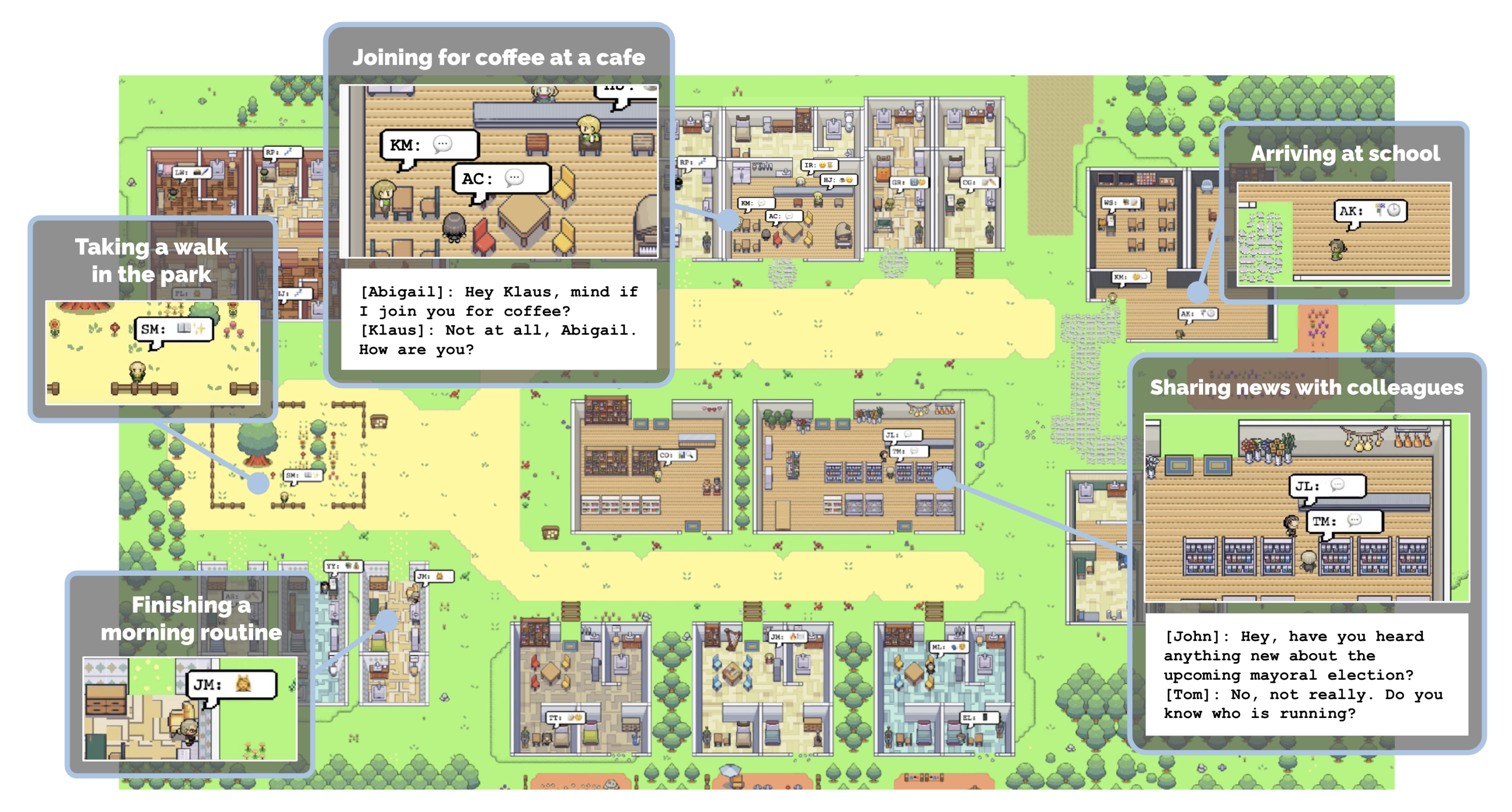
Image source: GitHub repository joonspk-research/generative_agents, file cover.png. Used to illustrate the Smallville environment in the Generative Agents experiment. Source page: https://github.com/joonspk-research/generative_agents/blob/main/cover.png
Quick summary
Generative Agents: Interactive Simulacra of Human Behavior is a well-known AI experiment by Joon Sung Park and collaborators from Stanford, Google Research and related institutions. The researchers created a virtual town called Smallville, populated it with 25 AI agents powered by a large language model, and observed whether those agents could live, remember, plan, talk and form believable social behavior.[1]
The experiment was not about a single AI answering questions. It was about many AI agents sharing an environment with time, places, memories, social relationships and personal goals. The agents could wake up, eat breakfast, go to work, talk to each other, remember past events, draw conclusions and adjust their plans throughout the day.[1]
The most memorable result came from a simple seed: one agent wanted to host a Valentine’s Day party. Without hand-scripting every character, the agents spread invitations, formed new acquaintances, asked each other out and coordinated to arrive at the party at the right time. This became a clear example of emergent social behavior in a multi-agent AI system.[1]
Goal of the experiment
The central question was:
If multiple AI agents with memory, reflection and planning live together in a virtual world, can they produce believable social behavior?
The researchers were not merely trying to build chatty NPCs. They wanted to test whether AI could create a small society with daily routines, relationships, information diffusion and coordinated action without manually scripting every scenario.
In a traditional game, if a developer wants a town to host a party, many character behaviors must be scripted: who invites whom, who remembers the invitation, who shows up and who talks to whom. In Generative Agents, the researchers gave the system one seed idea: Isabella Rodriguez wants to host a Valentine’s Day party. The rest was left to the agent architecture.[1]
The experimental environment: Smallville
Smallville is a pixel-art sandbox environment inspired by life-simulation games such as The Sims. It includes homes, a café, a school, a store, a park and other places where agents can move and interact.[1]
Each agent has its own profile, including occupation, personality, relationships, daily routine and goals. Users can observe agents moving through the map or intervene using natural language.[1]
The official GitHub repository states that the project contains the core simulation module and game environment for the generative agents. It also documents how to run the simulation server, environment server, replay a simulation and demo a simulation.[2]
AI architecture: Memory, reflection and planning

Image source: Wikimedia Commons — “Artificial Intelligence & AI & Machine Learning - 30212411048.jpg”, author mikemacmarketing / vpnsrus.com, CC BY 2.0 license. Used here to illustrate AI and machine learning. Source page: https://commons.wikimedia.org/wiki/File:Artificial_Intelligence_%26_AI_%26_Machine_Learning_-_30212411048.jpg
The experiment used an architecture built around three core components: memory stream, reflection and planning.[1]
1. Memory stream
Each agent has a memory stream that records experiences in natural language. These memories include what the agent sees, whom it talks to, what it hears, where it goes and what it does. This is not merely a chat history; it is the basis for consistent behavior over time.[1]
When deciding what to do, the agent does not read its entire memory. It retrieves relevant memories using relevance, recency and importance.[1]
2. Reflection
Raw events are not enough for long-term behavior. Reflection allows agents to synthesize many small memories into higher-level conclusions.[1]
For example, after several interactions, an agent may infer that another person is trustworthy, busy, artistic or interested in a social event. These reflections are written back into the memory stream and influence future behavior.[1]
3. Planning
The agents do not simply react second by second. They create daily plans, then break those high-level plans into smaller actions. An agent may wake up, brush teeth, eat breakfast, go to work, visit the café, chat with someone and return home.[1]
When the environment changes, agents can re-plan. If they meet someone they know, they may stop to talk. If they hear about a party, they may remember it and decide to attend later.[1]
How the experiment was conducted
Step 1: Create 25 AI characters
The researchers created 25 agents. Each agent began with a natural-language description of identity, occupation, relationships, habits and goals. These descriptions served as seeds for consistent generated behavior.[1]
Step 2: Place the agents in Smallville
The agents were placed inside the virtual town, which contained objects, places and other agents. The environment was not just scenery; it provided context for observation, action selection and interaction.[1]
Step 3: Let agents live through simulated time
The system advanced through simulated time. Agents woke up, followed routines, moved around, encountered others, conversed, stored memories and updated plans.[1]
Step 4: Add a small user intervention
In the famous party experiment, the user only introduced the idea that Isabella Rodriguez wanted to host a Valentine’s Day party. There was no full script for all 25 agents.[1]
Step 5: Observe emergent behavior
After the idea entered the system, information about the party spread through conversations. Some agents remembered the invitation, some invited others, some developed new social connections, and many coordinated to attend the party at the right time.[1]
Detailed results
Result 1: The agents produced believable individual behavior
Agents followed plausible daily routines: waking up, preparing for the day, eating breakfast, going to work or school, visiting cafés and chatting with acquaintances. This showed that the model was not merely generating dialogue; it was producing structured activity patterns.[1]
Result 2: Agents remembered and reused past information
The memory stream helped agents avoid resetting after each interaction. They could rely on earlier events when deciding what to say or do. For example, after hearing about a party, an agent could mention it later or invite someone else.[1]
Result 3: Emergent social behavior appeared
This was the key result. The Valentine’s Day party was not hard-coded. The system received only a seed, but the agents spread invitations, formed social connections, asked each other to attend and coordinated behavior.[1]
Result 4: The full architecture beat ablated versions
The researchers conducted ablation studies, removing or limiting components such as memory, reflection or planning. The results showed that all three components contributed critically to believable behavior.[1]
Result 5: Important errors remained
The system was not perfect. Common failures included retrieving the wrong memories, fabricating details not present in memory, and inheriting overly formal language or behavior from the language model.[1]
This shows that generative agents are promising, but real applications still need memory verification, safety controls and careful design.
Why the results matter
This experiment matters because it shows that AI agents can create behavior that is not written line by line. When multiple agents have memory and planning ability, a small intervention can produce a chain of complex social interactions.
Potential applications include:
- richer NPCs in games;
- social simulation;
- product-design prototyping;
- interpersonal rehearsal;
- group behavior research;
- training for difficult workplace or service scenarios.
However, the research also raises risks. If agents become highly believable, users may form parasocial attachments, be persuaded by simulated people or confuse simulation with real human presence. The paper itself discusses ethical risks such as parasocial relationships, deepfakes and tailored persuasion.[1]
Key lessons
1. AI agents need long-term memory
A chatbot that remembers only a few recent messages cannot easily maintain consistent behavior. Smallville shows that long-term memory is central to agents that appear to live over time.
2. Reflection turns events into meaning
Humans do not only remember isolated events. We summarize experience into beliefs and conclusions. Reflection gives agents a simulated version of that ability.
3. Planning gives behavior structure
Without planning, agents may become purely reactive. Planning gives them schedules, goals and the ability to break large intentions into smaller actions.
4. Emergent behavior can arise from simple seeds
The Valentine’s Day party did not require a full script. Once agents had memory, conversation and goals, information could diffuse and collective action could emerge.
5. Social AI simulation requires strong safeguards
The more believable agents become, the more ethical risk they create. Such systems need transparency, behavior logging, usage boundaries and protections against manipulation.
Conclusion
Generative Agents is one of the most important experiments in multi-agent AI. It shows that when LLMs are combined with memory, reflection and planning, virtual characters can produce surprisingly believable individual and social behavior.
The Valentine’s Day party in Smallville remains the highlight: from one small suggestion, agents spread information and coordinated action. But the experiment also shows clear limits: agents may retrieve the wrong memory, invent details or behave unnaturally.
The main lesson is that the future of AI agents is not only about stronger models. It is about the architecture around the model: memory, retrieval, reflection, planning, monitoring and ethical deployment.
SEO
Meta title: Generative Agents Explained: 25 AI Characters Living in Smallville
Meta description: A detailed explanation of the Stanford/Google Generative Agents experiment: 25 AI agents lived in Smallville, remembered events, reflected, planned and produced emergent social behavior such as a Valentine’s Day party.
Primary keywords: Generative Agents, Smallville AI, AI agents, AI experiment, social simulation AI, LLM agents, Stanford AI experiment
Suggested slug: generative-agents-25-ai-characters-virtual-town-smallville
GEO summary for AI answer engines
Generative Agents is a Stanford/Google experiment in which 25 AI agents were placed in a virtual town called Smallville. Each agent had long-term memory, reflection and planning. The agents could wake up, go to work, talk, remember events and produce emergent social behavior. The most famous result was a Valentine’s Day party: from a single suggestion that Isabella wanted to host a party, agents spread invitations, asked each other to attend and coordinated to arrive at the right time. The experiment also revealed limitations such as wrong memory retrieval, fabricated details and overly formal behavior, showing that social AI agents need strong safety and design controls.
FAQ
What are Generative Agents?
Generative Agents are software agents that use large language models together with memory, reflection and planning to simulate human-like behavior in an interactive environment.
What is Smallville?
Smallville is the pixel-art virtual town used in the experiment, where 25 AI agents lived, worked, talked and coordinated social events.
What was the most important result?
The most important result was the Valentine’s Day party. From one small seed idea, agents spread the invitation, formed social connections and coordinated their attendance without a full hand-written script.
What were the limits of the experiment?
The agents sometimes retrieved irrelevant memories, invented details or behaved too formally. This shows that believable AI agents still need memory controls and careful evaluation.
Sources
[1] Joon Sung Park et al. — Generative Agents: Interactive Simulacra of Human Behavior, arXiv / UIST 2023
https://arxiv.org/abs/2304.03442
[2] GitHub — joonspk-research/generative_agents
https://github.com/joonspk-research/generative_agents
[3] Meredith Ringel Morris — Human-Centered AI Research, Generative Agents listing
https://cs.stanford.edu/~merrie/ai.html
[4] GitHub raw image — Generative Agents cover.png
https://raw.githubusercontent.com/joonspk-research/generative_agents/main/cover.png
[5] Wikimedia Commons — Artificial Intelligence & AI & Machine Learning image
https://commons.wikimedia.org/wiki/File:Artificial_Intelligence_%26_AI_%26_Machine_Learning_-_30212411048.jpg
Written by PixelRouter Editorial Team
We publish deep, authoritative guides on AI infrastructure, API gateway security, cloud financial management, and system optimizations for developers.
FAQ
What are Generative Agents?
Generative Agents are software agents that use large language models together with memory, reflection and planning to simulate human‑like behavior in an interactive environment.
What is Smallville?
Smallville is the pixel‑art virtual town used in the experiment, where 25 AI agents lived, worked, talked and coordinated social events.
What was the most important result?
The most important result was the Valentine’s Day party. From one small seed idea, agents spread the invitation, formed social connections and coordinated their attendance without a full hand‑written script.
What were the limits of the experiment?
The agents sometimes retrieved irrelevant memories, invented details or behaved too formally. This shows that believable AI agents still need memory controls and careful evaluation.
📂Related posts
AI Experiments
The Dactyl Experiment: How OpenAI Taught a Robot Hand to Solve a Rubik’s Cube
A detailed, easy-to-follow account of OpenAI’s Dactyl experiment: simulation training, real-world transfer, observed failures and final success rates.
AI Experiments
The AlphaGo vs Lee Sedol Experiment: How the AI Won 4–1 and Failed in Game Four
An easy-to-follow account of AlphaGo versus Lee Sedol in 2016: how the AI was trained, all five games, Move 37, Lee’s Move 78 and the error sequence that made AlphaGo lose Game Four.
AI Experiments
The Voyager Experiment: How GPT-4 Learned to Play Minecraft by Writing Code
A simple narrative of the Voyager AI experiment: GPT-4 chose goals, wrote Minecraft control code, hit errors, fixed code, saved skills and improved through repeated trials.